

REFLECTIONS
A Note on the Journey
My work over the past seasons has been deeply shaped by the writings of Bernadette Roberts. Her articulation of the interior journey gave language to experiences I trusted but could not yet name. For that, I remain profoundly grateful.
What is unfolding now is a pivot from that year with her. The blog will still be reflective in nature, but focused on different material. Something lived more explicitly in the body, in relationships, and in the ordinary moments where patterns reveal themselves and something new becomes possible.
I find myself at a threshold. There is energy here, curiosity, creativity, a sense of alignment, and also a necessary unknowing. Rather than certainty, what feels most faithful is attention.
In this season, my writing and work are pivoting toward presence as a lived reality, often through the lens of the Enneagram, not as a system to master, but as a doorway into embodiment, awareness, and honest engagement with life as it is.
This space will continue to reflect on the inner journey, but with a growing emphasis on how that journey shows up in real time: in the body, in conflict, in growth, and in the courage it takes to stay present when old strategies no longer serve.
If you are sensing a threshold of your own, you are welcome here.

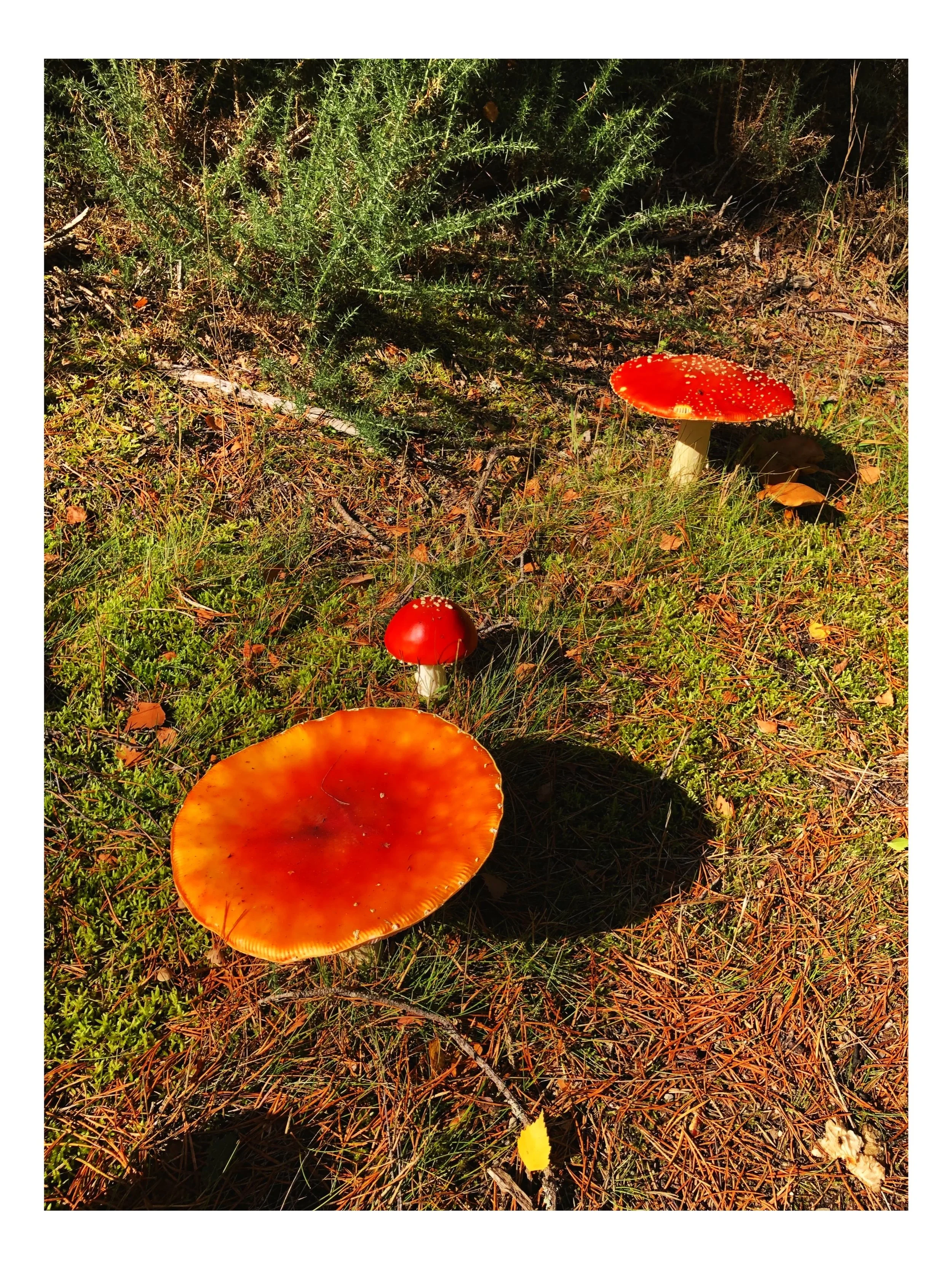
God in Nature - Paragraph 1
The invitation this text extends to me is the importance and exploration of “wow” moments. This exploration does not mean grasping for such moments or even an expectation that they occur, but instead an invitation to cultivate a slow and steady stance towards receptivity. What does it mean to be in nature and be open? I’m I attuned to the weather, season, or plant life near me? Why am I rushing by what is around me on my way to something else believing that something else is what holds the key to some imagined future happening? The Dalai Lama said “ rushing is a form of violence.” I agree, if you pay attention to rushing you will feel the energetic signature of violence, the pushing, the overbearing, the dismissing.
Foundation of all Revelations - Paragraphs 4 and 5
I honestly believe that everyone has encountered this simple definition of knowing and two examples spring to mind. The first example is the experience of the sunset. You were not expecting it, but there you are, rapt, and for a few moments you are one with the sunset. You have dropped your stories, your worries, and you are just there. This “thereness” is what Roberts means by knowing. You are not sure what you are knowing, except to say it is lovely. The other example that comes to mind is witnessing a birth. There is something extraordinary about new life and all the innocence and vulnerability it bears on you. Again, for a few moments you are moved beyond words, and there really is no expression of what you are experiencing, except to say that your heart is full beyond measure.

Foundations of all Revelations - Paragraphs 2 and 3
These paragraphs feel like a wild ride indeed and her experience of people either getting it, this idea of a knowing beyond our intellect, or not getting it is a true statement. For some people, Roberts’ words may seem no more than an unsolvable riddle and for others, who may be interested in such riddles, the obtuseness of a knowing that knows is difficult to apprehend. Frankly, in sitting with these words I am wondering what I could write or add to what she has already said that would make any sense at all.

Foundations of all Revelations - Paragraph 1
So what am I understanding her to be saying? There are a couple of things that come to mind. First, we can not insist, grasp, or intellectualize our way to this This. The second is implied, but given there are many mystics, masters, and teachers who write about revelatory things from a place of certainty than there must be a path we can traverse in order to come in contact with such “knowing.” Such a path seems to open us to both a new way of “knowing” and the “knowing” itself; the This. There are, of course, many paths and practices, but as Jim Finley says, “once you find your path, practice it.” A.H. Almaas would say “worship it.”

God’s Major Revelations - Paragraphs 2 and 3
The question you may ask is how does one build such a capacity? One way is through practices, meditative and inquiry practices for instance, but also through trial and error. There is no better way to find the truth than blunder upon it. Our society doesn’t reward or recognize such a method, but trial and error takes a certain fortitude and courage that is particularly underrated by today’s standards. There is a certain joy in trial and error, even a certain playfulness. Jesus said we must be like children, who seem impervious to results. May you be full of joy today!
God’s Major Revelations - Paragraph 1
I love this paragraph because of its hominess and messiness, which depicts so well what happens within the confines of our ordinary lives. Just like Roberts, we often have a certain something in mind that feels like a direction in which we are moving only to find that pieces of what we wanted to do are just not going to be possible. We must stop, take stock, pivot, and then carry on. I do not sense from her any frustration or disappointment with this (common) development, but instead a mature ability to pivot her essay in a direction that still meets the need of what she is trying to convey.
The True Nature of Integration - Paragraphs 6 and 7
We find today in Roberts’ text a final word on integration, of which I would call surrender. She has said it in many ways, not just through this subsection, but throughout her text, that the mind alone can not understand the Mystery that is at work in our soul. In my experience there is a sort of relinquishment of the reins (surrender) when the mind can’t understand what is happening at the soul level. She has also said in various ways that this “mind” or “intellectualizing” is a pitfall that comes easy to us. We will be tempted to do it therefore we must learn another way to move forward.
The True Nature of Integration - Paragraph 5
From this recap we can understand why “bookish knowledge of the journey” will not suffice. It ties back to the “two different modes of human knowing” that were laid out earlier in her text. She classified these modes of knowing as “thought and experience” and it is her position that these ways of knowing are of “two totally different dimensions.” Roberts’ “this” then refers to the human propensity to miss the mark, the inclination to stay on the surface of things where we feel we have control over the outcome of things. Not to trivialize the surface, but there is a whole lot more under the surface of almost everything.
The True Nature of Integration - Paragraph 4
I have discovered that the stair-step movement, both vertical and horizontal as Roberts says, takes a radically intentional and attuned life. We’ve talked before about the need for practices and community that can ground you into such radicality. Even with practices and community I often feel helpless in my inability to sustain such a dedicated life and when my propensity to scatter myself arises, I can recognize the disservice to myself and also to that which beckons me. Being an Enneagram Nine I recognize the strong habit of mind towards disengagement and the egoic patterning of keeping everything at distance. A great sadness can arise in me when I ponder this habit as I realize I not only keep the world at a distance but the Mystery as well.

The True Nature of Integration - Paragraphs 2 and 3
Today I am more comfortable with the unknown place. Those liminal spaces we must stand in before we cross over into the next thing. Love has not let me down nor disappointed, and even with more ease, curiosity, and comfort in the Mysterious unknown, Roberts’ words invite a continued pressing into those uncomfortable places where Mystery leads me forward. Her words encourage me to surrender so that the Mysterious integration may be worked in me. May it be so.
The True Nature of Integration - Paragraph 1
But before we get started the first thing I notice is that she seems to be saying two things that do not jive. First she says “that integrating these revelations is not within our own power.” Then she says that we should ask questions such as how does a revelation “fit in with all that went before?” and “how are we to account for these different revelations?” She also implies that we “ponder our relationship” to them, meaning the revelations and their relevance to our life. If it is not in my power to integrate the revelations why is she implying we take hold of them and make sense of them? I honestly don’t know the answer to this question except to say that it seems to be a part of the journey. While we may not be the ones actually doing the integrating, it is some hidden and secret work, we are responsible for aligning ourselves to that which is new.